DJATD-Commitment to Cross-Movement Organizing
“Shifting how social justice movements understand disability and contextualize ableism, disability justice lends itself to politics of alliance.”
This month I offer gratitude to the researchers, writers, journalists, historians, archivists, and others who have recorded and preserved the events of their day as completely and objectively as possible because that makes the type of sharing I offer possible.
Noble Eight-Fold Path
One of Shakyamuni’s Many Lists
Through developing this Disability Justice and the Dharma series so far, I’ve more fully come to understand differences between how Shakyamuni taught about truth and peace and how these concepts were communicated by Indigenous Americans. As I’ve started to digest the Iroquois teachings in And Grandma Said…, I’ve come to sense that, in the oral traditional of Indigenous Americans, teaching truth and peace wasn’t about telling you what to do or to know, it was about inviting you into experiencing, into listening deeply inside yourself, to receive not just the words but the environment and intentions into which the words were spoken, and to metabolize all of that into your being.. When we receive the call for truth and peace so deeply that we metabolize and embody it, we begin to become peace, we begin to become truth. From this, I begin also to suspect that Shakyamuni’s style of teaching, with his great love of lists, and principles, and strictures, had a natural appeal to modern Western cultures that were already significantly divorced from the body and deeply enmeshed in the mind. I don’t mean to imply that I have begun to devalue Shakyamuni’s teachings, but that I experience greater and greater distance from disembodied Western interpretations and transmissions of what Shakyamuni communicated as lists and principles and strictures. With all of that in bodymind, our gathering this month started by digesting The Noble Eight-Fold Path as set out in Dhammadinna’s groupings.
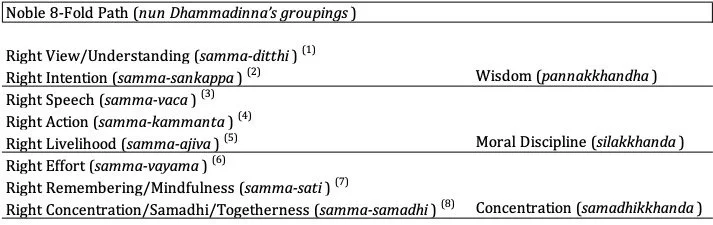
I am coming to understand that the “wisdom” elements in Dhammadinna’s analysis point us toward work with our perceptions and the ways in which our perceptions form our intentions. Similarly, the “moral discipline” elements illuminate the multiple levels through which our cultivated wisdom is communicated into the world and encourage us to use self-disciple to maintain a deep connection to our inner wisdom in all of our creative acts. I see the “concentration” elements not as related to the mind (as in thinking hard or concentrating), but as being the distilled or essential outcome of wisdom and moral discipline. The “concentration” elements, like vanilla extract or essential oils, indicate great intensity and powerful impact. While all of the elements of the Noble Eight-Fold Path are present simultaneously in all of the Sin’s Invalid’s principles of Disability Justice, the action-oriented principle of Commitment to Cross-Movement Organizing is a committed distillation of the practice of Right Effort, which Sangha Is All defines as cultivating and nurturing our full, complete, very best, vigorous effort infused with focused and concentrated will so that energy can be brought into our Right Actions with dedication and persistence.
Disability Is The Ultimate Intersectional Identity
Many times, political and social justice movements see each other as unrelated or even competing with each other. Because disability exists in all bodies, all identities, all moralities and consciousnesses, practicing disability justice requires a commitment to organizing across all of these identities. Consider also: all marginalized identities are generally considered somehow less than some artificial norm, somehow incapable. Thus marginalization, inherently, is a disablement. All of this means disabled folks need to maintain deliberate conscious awareness, cultivating our very best efforts, our very best awareness, in order to move into various-identity, multi-marginalization, cross-movement partnerships. Passing the Americans With Disabilities Act of 1990 (ADA) involved significant intersectional success; it was the culmination of years long, significant intersectional, cross-identity organizing and action.
To illuminate this, I constructed a number of tables this month, shown below. The first depicts US federal disability-related acts and reflects that in the post-World War I period, when significant numbers of people became disabled in combat, US federal law began to recognize a benefit to returning non-normative bodies to the workforce and passed the first federal laws to enable this. In this table we see a 72-year arc between the first federal law dealing with vocational rehabilitation and employment of disabled people to passage of the ADA, starting just 2 years after passage of the federal law supporting disabled veterans. We see that US awareness relating to disability continued to expand, culminating with the Rehabilitation Act of 1973 that, according to Lennard J. Davis, “breaks and enters” the concept of civil rights as being related to disability into US consciousness.
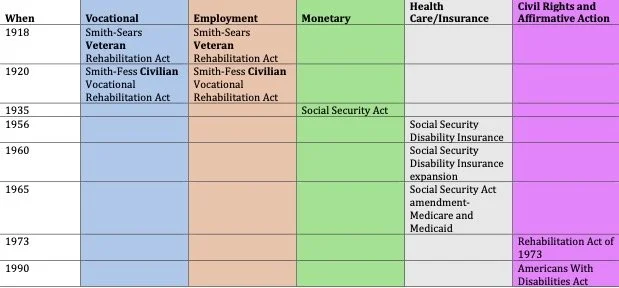
US federal disability-related acts
The second table offers an expanded view by documenting other US federal civil rights and health care/health insurance laws. This also expands the table 1 timeframe. Here we see a consciousness began to coalesce that federal law would be required to establish equity (in law at least) among people of various identities and abilities, starting with the 13th constitutional amendment abolishing slavery in 1865, and the related Civil Rights Act of 1875. In the 98-year period between 1875 and 1973, civil rights, economic, and healthcare-related legislation dealing with race, gender, and disability passed into US law.
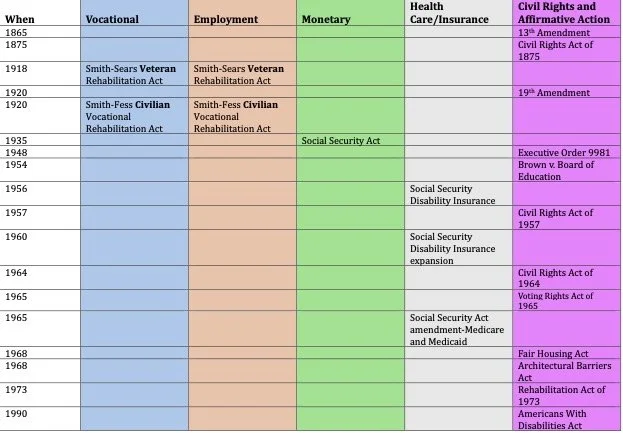
Expanded US federal civil rights and healthcare-related acts
Disability is the ultimate intersectional identity. There is no human body exempt from the possibility of disability and, in fact, as bodies age some level of disability is experienced by almost everyone. There is no age, gender, race, ethnicity, orientation, economic class, or other identity exempt from disability. In order to pass the ADA, many intersections needed to be activated. The concerted activism that led to writing and passing the ADA started in 1979 in Berkeley, California when a group of disabled people realized that its local Disability Rights Education and Defense Fund needed to expand to a national focus. This group moved to Washington, DC in 1980 with the goal of changing Washington’s thinking about disability “from a diseased in need of remediation to a political position [or intersection] in need of civil rights.” Nine years later, individuals from both political parties and persons with differing and significant person experiences with disability participated in the final efforts that brought the ADA into US law.
Intersectional Failure
“I would say, intersectional failure is the consequence of a political vision that is meant to be transformative but it fails to fully interrogate many of the baselines upon which it is activated and in that failure it makes itself vulnerable to political conditions that actually rob the movement of its ability to do what it even claims it wants to do.” Kimberle Kremshaw
To explore the workings of intersectionality more fully, an examination of intersectional failures relating to civil rights identities emerging in the US since the 1950s is helpful; this month’s recording reflects both my own and participants’ reflections on intersectional issues on bathroom access, disability deinstitutionalization and the prison industrial complex, feminism and marginalization of femme people of color, the economic cost of mass transit accessibility, social immunity and communicable disease vulnerability.
The final table below expands on the previous two by including social context. By expanding our view in this way, we see various impacts, the US Civil War, the intersectional failures of Reconstruction, the Great Depression, the US’ first disabled President, and repeated wars, on activation of many marginalized identities, people of color, war veterans, women, older people, and people who live with disabilities from many causes, to right their marginalization through US civil rights and healthcare laws. The Great Depression, for instance, a significant economic equalizer, influenced passage of the Social Security Act, signed into law by US’ first disabled president, Franklin Delno Roosevelt, in 1935. After that, a cascade of wars continued to enlarge the US disabled population and intersectional interest in disability justice. Intersectional failures at the end of the US Civil War as the US effected Reconstruction underpin continued racial injustice in the US today. At that time, while the US Congress was concerned that rapid reconstruction of succeeded states back into the United States without significant concessions and strictures would enable the southern states to return to business as usual, and in fact passed the Wade-Davis Bill to impose those concessions and structures, it was blocked first by Abraham Lincoln then by his successor Andrew Johnson. A lenient reconstruction plan that allowed succeeded states to reconstitute into the US swiftly was enacted and the reconstituted southern stated enacted Jim Crow laws consistent with successionist sensibilities, ultimately necessitating the Civil Rights Law of 1875. Damage to the social/racial fabric of the US that has yet to be recognized or repaired was done through rapid reconstruction; failure was snatched from the jaws of success. As the disability justice community sees quite clearly, lack of racial equity remains a major problem in the US today over 150 years later.
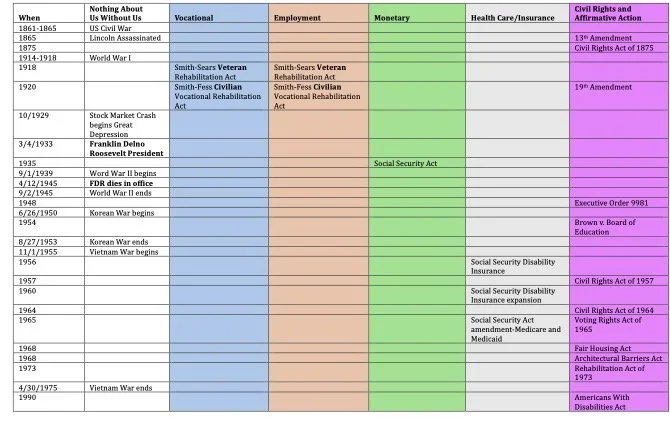
US federal civil rights and health care law with expanded social context
Awareness of intersectional failures like these is an essential component of embodied awareness as the practice of being with the true nature of reality, not just ultimate reality, but the relative reality of the imperfections of humanity. Without awareness that what I am awake to is not what everyone else is awake to, how can I support awakening? Without awareness of my own imperfections and blindnesses, how can I effectively establish intersectional relationships that support all bodies? This practice is not easy, but it’s essential. Sangha Is All exists as a call to that practice.
***
Thank you for gathering with me to examine Commitment to Corss-Movement Organizing and being a valuable part of Sangha Is All. I’m looking forward to being with you again in January for sharing and discussion on Recognizing Wholeness.
Remember, if you want to receive gathering reminders, register here. Eventbrite requires separate registration for each month. Click “Check Availability” on the right side of the event page and select the date(s) you want to register for. Until then, utilize the resources linked below, revisit any of our recordings, and, if convenient, practice with us on Thursdays at 1pm US central time.
Sangha Is All Word Bank:
Dharma – essentially truth, or the true nature of reality.
Disability –(a) having a natural body that performs natural functions in accordance with its unique capabilities;
(b) a label applied in ableist culture to create an artificial division between people into prescribed “normative” and “non-normative” categories for purposes of exclusion.
Noble Disciple - a person who practices for awareness is one who seeks the true nature of reality, tires to look straight into the true nature of reality, has perfect confidence in the true nature of reality, and is always seeking to arrive at the true nature of reality.
Samma Dhitti (Right View) - A perspective reflecting a balanced and intentional gaze toward a profound understanding of the true nature of reality.
Samma Sankappa (Right Intention) - Seek out, nurture, and encourage thoughts and intentions that are in balance with the true nature of reality.
Samma Kammanta (Right Action) - In all aspects of life, consciously engaging in activities that seek to create balance with the true nature of reality.
Samma Ajiva (Right Livelihood) – Engaging in means to earn one’s living, regardless of the economic system utilized, in equanimity and balance with the true nature of reality.
Samma Vayama (Right Effort) - Cultivating and nurturing our full, complete, very best, vigorous effort infused with focused and concentrated will so that energy can be brought into our Right Actions with dedication and persistence.
Sangha Is All Playlists
September 7 – Ali Farka Toure and Toumani Diabate Debe and Kala
October 5 - Robert Macht Vishnu and Pelawak
November 2 - Average White Band – Pick Up The Pieces and Sly & The Family Stone – I Want to Take You Higher
December 7 - Community - Christmas Infiltration, Adam Sandler - The Chanukah Song, and Gayla Peevey - I Want A Hippopotamus for Christmas
November 7 Links:
Recording - Disability Justice and The Dharma-Commitment to Cross-Movement Organizing
Lennard J. Davis, Enabling Acts
Doris Zames Fleischer and Frieda Zames, The Disability Rights Movement (affordable copies are available from used book resellers)
Eric Foner, The Fiery Trial, Abraham Lincoln and Slavery
Disability Is Not Inability T-shirt
November 7 Quotes:
From Kimberle Crenshaw, Liberty Equality. Intersectionality. An antidote against fascism,
“Intersectional failure is the consequence of a political vision that is meant to be transformative but it fails to fully interrogate many of the baselines upon which it is activated and in that failure it makes itself vulnerable to political conditions that actually rob the movement of its ability to do what it even claims it wants to do.”
Ways to Practice Together Until Recognizing Wholeness on January 4:
Sangha Is All Embodied Awareness Practice, Thursdays at 1pm CT
Southsea Sangha’s Earthworm Sangha, a monthly meditation group run by and for disabled, neurodivergent, and chronically ill people. Scroll to the bottom of this page to find more information and to register.
Bodhi Bodies, a monthly practice group run by and for disabled people as part of the World Interbeing Sangha (Thich Nhat Hahn’s Plum Village tradition). Click here for more information and to register.
Mindbody Solutions, yoga and community offerings.