DJATD-Anti-Capitalistic Politic
“In an economy that sees land and humans as components of profit, we are anti-capitalist by the nature of having non-conforming body/minds.”
What Is Disability
It’s no secret; anyone who’s spent a little time with me knows I love words, and part of my practice in Disability Justice and the Dharma has been to examine words, what they mean and how we use them, but so far I’ve largely focused on Sanskrit words from the Buddhist tradition, trying to tease out helpful, contemporary meanings. Last Sunday, I turned to an English word: “Disability”. The effect of this word on individuals, in varying contexts and conversations, is complicated and can be socially and emotionally fraught. Some people, particularly those normatively abled, seem completely unaware of these effects, while others are left open-mouthed at both the impacts and lack of awareness. Fascinatingly, the traditional worldview of indigenous North American people did not even involve a concept of “disability,” nor its corollary “able-bodiedness.” Examining teachings from Kim E. Nielsen’s A Disability History of the United States and Sakokewnionkwas’ (Tom Porter’s) And Grandma Said.. Iroquois Teachings as passed down through the oral tradition, we learn a completely different value system around the inherent worth of all beings which instructs that meaningful contribution is not linked to the size, shape, ability, or other configuration of a “body.” Inspired by these teachings and my own experiences, Sunday I volunteered two new definitions of “disability:”
– having a natural body that performs natural functions in accordance with its unique capabilities;
– a label applied in ableist culture to create an artificial division between people into prescribed “normative” and “non-normative” categories for purposes of exclusion.
Indigenous Iroquois wisdom practiced an understanding that an individual’s inner relationship with their own body, spirit and mind needed to be in harmony before a balanced relationship within the community, one of reciprocity in which each individual contributes in accordance with their unique gifts and abilities regardless of the configuration of their body, could be struck and maintained.
Balance
“Balance requires that the entirety be recognized and embraced.” Kim E. Nielsen, A Disability History of the United States
Sakokewnionkwas’ sharing of the ritual “What We Say Before We Do Anything Important,” referred to in English as the Thanks Giving or Opening Address, gives us great insight into what “balance” meant to the Iroquois people. He calls this ritual “the skeleton key that opens every door.” A historian might look at this ritual as a retelling of an indigenous creation story, but this would be a very superficial understanding of its content, intent, and impact. In fact, what this ritual points to is the deeply embodied intent to connect with the living interrelationship and between humans and the entire natural world in all its aspects as a prerequisite to decision-making. Metabolizing this ritual’s content and the time devoted to it are thoroughly anti-capitalist.
Capitalism
If this Planet was a body, I would say that it has a disease. There could be many names for it, brutality, hatred, Shakyamuni called it delusion. Perhaps the name of the disease is not as important as the medicine, which is to keep ourselves as cells in the body as clean and healthy as possible.
Last month, while examining Leadership of the Most Impacted, we looked at the Cakkavatti Sutta and saw the elements of leadership that Shakyamuni prescribed as necessary to provide the kind of humane and ethical leadership that leads to “prosperous” and “beautiful” citizens. Shakyamuni offered these elements in in the context of monarchy, a system most people in the US are not particularly attracted to today. I don’t dispute Sins Invalid’s principle of anti-capitalist politic; at the same time, I choose to refocus my awareness on how ancient wisdom points more to how leadership is carried out as either problematic or healthful rather than the specific structure under which it occurs. In the US, it’s our implementation of capitalism that creates inequities, imbalance, extreme poverty, and ill health. Wikipedia has a long list of economic systems, including Communism, Socialism, Anarchy, and Capitalism. We’ve heard horrible things about all of these. It’s not the system per se that is inhumane or unjust. The way people choose to implement any chosen system can be just or unjust. Last Sunday, we quickly reviewed some of the foundationally problematic elements in US capitalism, slavery, voting restrictions, immigration laws and practices, and body autonomy laws and perspectives. Unsurprisingly, these same 250-year-old issues continue to drive heated contention in our political world and create threats and disadvantages in personal lives today.
An ethic that accumulation of the utmost possible whatever the consequences for other living things anywhere in the world is inherently sociopathic. Sociopathic systems cannot serve living beings.
What is Right Livelihood, and HOW As DISABLED people DO WE ENGAGE IN RIGHT LIVELIHOOD IN THIS CAPITALIST SOCIETY?
Practice is everything and everything is practice.
Going back to the dharma, let’s remember that knowledge systems, which are what fuel our social and economic systems, can be built from any information for any purpose. In order for knowledge to lead to wisdom and liberation, Shakyamuni suggested it must:
• Reflect and adopt a perspective reflecting a balanced and intentional gaze toward a profound understanding of the true nature of reality {RIGHT View] AND
• Seek out, nurture, and encourage thoughts and intentions that are in balance with the true nature of reality [RIGHT Intention]
These are the “Wisdom” elements of Shakyamuni’s Eightfold Nobel Path. In examining Leadership of the Most Impacted, I suggested that Right Action – which is a Moral Discipline element – ethically must arises from the Wisdom elements. Lack of awareness, perspective, attention, and time to the real causes of inequity make solving inequity impossible. Awareness developed but not acted upon has little impact. We practice, as Shakyamuni repeatedly suggested, to see for ourselves with our own unique view, in our own unique bodies, through our own unique incarnation. As persons living in disabled bodies, our practice rightfully seeks to understand and honor our unique capacities and devotes time and attention to the problem solving that is within our capacities, doing what we can in the ways we can. While I suggest right livelihood might be defined as engaging in means to earn one’s living, regardless of the economic system utilized, in equanimity and balance with the true nature of reality, understanding our bodies as anti-capitalist, we also understand the word “earn” to encompass the wholeness of contribution to balance and not simply the accumulation and use of money.
We need medicine to keep ourselves whole and functioning in this world. One tool the indigenous Iroquois people used What We Say Before We Do Anything Important. Shakymuni Buddha suggested we start with establishing Right View and Right Intention. Whatever we want to call the dis-ease we are living under, and whatever methods or techniques for personal care we personally connect with, we need to keep ourselves, as cells in the body of the world, as clean and healthy as possible, because health can be just as contagious as dis-ease. Especially because, as “disabled” people, we understand and experience the marginalization and isolation that results from this iteration of capitalism, whatever we choose to practice, we must seek out and nourish reliable partnerships with others who are working with and toward these kinds of awarenesses – because community is everything.
I intend the offering of Disability Justice and the Dharma as one of my contributions toward balance. I hope you experience your presence in these offerings is part of yours.
***
Thank you for gathering with me to examine Anti-Capitalist Politic and being a valuable part of Sangha Is All. I’m looking forward to being with you again in December for sharing and discussion on Commitment to Cross-Movement Organizing.
Remember, if you want to receive gathering reminders, register here. Eventbrite requires separate registration for each month. Click “Check Availability” on the right side of the event page and select the date(s) you want to register for. Until then, utilize the resources linked below, revisit any of our recordings, and, if convenient, practice with us on Thursdays at 1pm US central time.
Sangha Is All Word Bank:
Dharma – essentially truth, or the true nature of reality.
Disability – having a natural body that performs natural functions in accordance with its unique capabilities; also
– a label applied in ableist culture to create an artificial division between people into prescribed “normative” and “non-normative” categories for purposes of exclusion.
Noble Disciple - a person who practices for awareness is one who seeks the true nature of reality, tires to look straight into the true nature of reality, has perfect confidence in the true nature of reality, and is always seeking to arrive at the true nature of reality.
Samma Dhitti (Right View) - A perspective reflecting a balanced and intentional gaze toward a profound understanding of the true nature of reality.
Samma Sankappa (Right Intention) - Seek out, nurture, and encourage thoughts and intentions that are in balance with the true nature of reality.
Samma Kammanta (Right Action) - In all aspects of life, consciously engaging in activities that seek to create balance with the true nature of reality.
Samma Ajiva (Right Livelihood) – Engaging in means to earn one’s living, regardless of the economic system utilized, in equanimity and balance with the true nature of reality.
Sangha Is All Playlists
September 7 – Ali Farka Toure and Toumani Diabate Debe and Kala
October 5 - Robert Macht Vishnu and Pelawak
November 2 - Average White Band – Pick Up The Pieces and Sly & The Family Stone – I Want to Take You Higher
November 2 Links:
Recording - Disability Justice and The Dharma-Anti Capitalist Politic
Kim E. Nielsen, A Disability History of the United States
Tom Porter (Sakokwenionkwas), And Grandma Said…
Aurora Levins Morales Bigger is Better blog
Thich Nhat Hahn, The Art of Living also available on Spotify
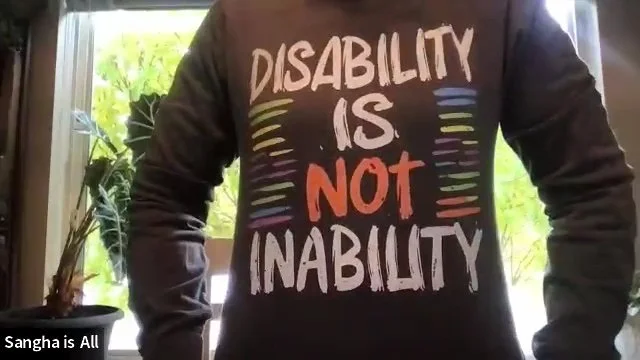
Disability Is Not Inability T-shirt
November 2 Quotes:
From: Kim E. Nielsen, A Disability History of the United States:
Indigenous North America, pre-1492
“In the traditional indigenous worldview of North American peoples, it is believed that every person and thing has a gift (a skill, ability, purpose). When individuals, communities, and the world are in harmony, individuals, often with the help of others, find and embrace their gifts and put them into practice. For example, a young man with a cognitive impairment might be an excellent water carrier. That was his gift.”
“Just as the contemporary word ‘disability’ had no comparable concept, the contemporary phrase ‘able-bodiedness’ would have little meaning. Because the body was not separate from one’s spirit and mind, an ‘able body in and of itself would be inconsequential.’ Only if the spirit, body, and mind were in harmony did indigenous communities consider a person to be well—regardless of whether that person was blind, experienced chronic pain, or walked with a dance-like lilt.”
“nearly every indigenous-language group [prior to European invasion] used signed communication to some degree, and many nations shared signed languages despite verbal linguistic differences.” [lots of languages– according to Wikipedia, north American indigenous population estimates prior to European arrival range from 2.5Million to 18Million].
“Balance requires that the entirety be recognized and embraced.”
The Late Colonial Era, 1700 -1776
“The racist ideology of slavery held that Africans brought to North America were by definition disabled.”
(Creating Citizens, 1776-1865)
“In the decades following the American Revolution, the new nation sought to define and distinguish between good and bad citizens. Democracy was a grand and potentially dangerous experiment that presumed its citizens could and would make reasoned political decisions. How could the new republic survive unless the bodies and minds of its citizens were capable, particularly its voting citizens? Political theorists contrasted idiots, lunatics, women of all races, people of indigenous nations, and African Americans with those considered worthy of full citizenship. States increasingly developed disability-based voting exclusions, alongside and often as a part of those of race and gender. Inherent to the creation of the United States was the legal and ideological delineation of those who embodied ableness and thus full citizenship, as apart from those whose bodies and minds were considered deficient and defective.”
“In the years following the American Revolution….Disability became one ideological means by which to adjudicate worth citizenship….early immigration law…had tried to prevent the ‘lame, impotent, or infirm persons incapable of maintaining themselves’ from landing ashore…1848 Massachusetts and Alabama used what is now know as an LPC (‘likely to become public charge’) clause.”-
The Progressive Era, 1890 -1927
“People with disabilities fought against increasingly stringent and harsh laws and cultural attitudes, but despite their efforts the definition of ‘undesirable’ became ever more wide, fluid, and racially/ethnically based. Physical ‘defects,’ both scientists and the casual observer increasingly assumed, went hand in hand with mental and moral ‘defects.’ This resulted in the forced sterilization of more than sixty-five thousand Americans by the 1960s, and in the most restrictive immigration laws in US history (that, among other things, excluded people with disabilities).”
From Tom Porter (Sakokwenionkwas), And Grandma Said…
The “Thanks Giving Adddress”, What We Say Before We Do Anything Important is “…the skeleton key that opens every door…is for our Six Nations., our humand people, it’s our skeleton key to the world we live in.”
“…so we have a little handicap more than other living things….humans, we always try to be somebody we’re not. Always got a mask on.”
[So Creator made the Four Beings] “They’ve been assigned especially to babysit us because of that one fault we have, of not being able to tell the truth for what it is.”
“One of them would volunteer to be born as a human” [Examples of the Foour Beings: Peacemaker, Buddha, Confucious, Jesus]
On keeping the peace: “Put your whole heart in what you learned, so that the spirit of our ancestors, our Creator, and Our Peacemaker can talk right through your body and use you, so that you can communicate peace. And then our people, we will get better. Our people will be united again.”
From Aurora Levins Morales Bigger is Better blog: “…anytime what we're fighting for brings us into conflict with the legitimate needs of another group of people, it's a sure sign that the picture is too small.”
From Kimberle Crenshaw, Liberty Equality. Intersectionality. An antidote against fascism,
“Intersectional failure is the consequence of a political vision that is meant to be transformative but it fails to fully interrogate many of the baselines upon which it is activated and in that failure it makes itself vulnerable to political conditions that actually rob the movement of its ability to do what it even claims it wants to do.”
From Thich Nhat Hahn, The Art of Living:
"When we stop to breathe, we’re not wasting time. Western capitalist civilization says 'Time is money' and that we should use our time to make money. We can’t afford to stop and breathe or enjoy a walk or marvel at the setting sun. We cannot afford to lose time. But time is more precious than money. Time is life. Coming back to our breathing and becoming aware that we have a wonderful body— this is life."
“Spirituality is not religion. It is a path for us to generate happiness understanding and love so we can live deeply each moment of our life. Having a spiritual dimension in our lives does not mean escaping life or dwelling in a place of bliss outside this world, but discovering ways to handle life’s difficulties and generate peace, joy, and happiness right where we are, on this beautiful planet. The spirit of practicing mindfulness, concentration, and insight in Buddhism is very close to the spirit of science. We don’t use expensive instruments but rather our clear minds and our stillness to look deeply and investigate reality for ourselves with openness and non-discrimination.”
Other Ways to Practice Together Until Commitment to Cross-Movement Organizing on December 7:
Sangha Is All Embodied Awareness Practice, Thursdays at 1pm CT
Southsea Sangha’s Earthworm Sangha, a monthly meditation group run by and for disabled, neurodivergent, and chronically ill people. Scroll to the bottom of this page to find more information and to register.
Bodhi Bodies, a monthly practice group run by and for disabled people as part of the World Interbeing Sangha (Thich Nhat Hahn’s Plum Village tradition). Click here for more information and to register.